
touch-less-infrared-sensor-kitchen-faucet-812-chrome
A faucet we fabricate and install — see it in real kitchens below, then get your free quote.
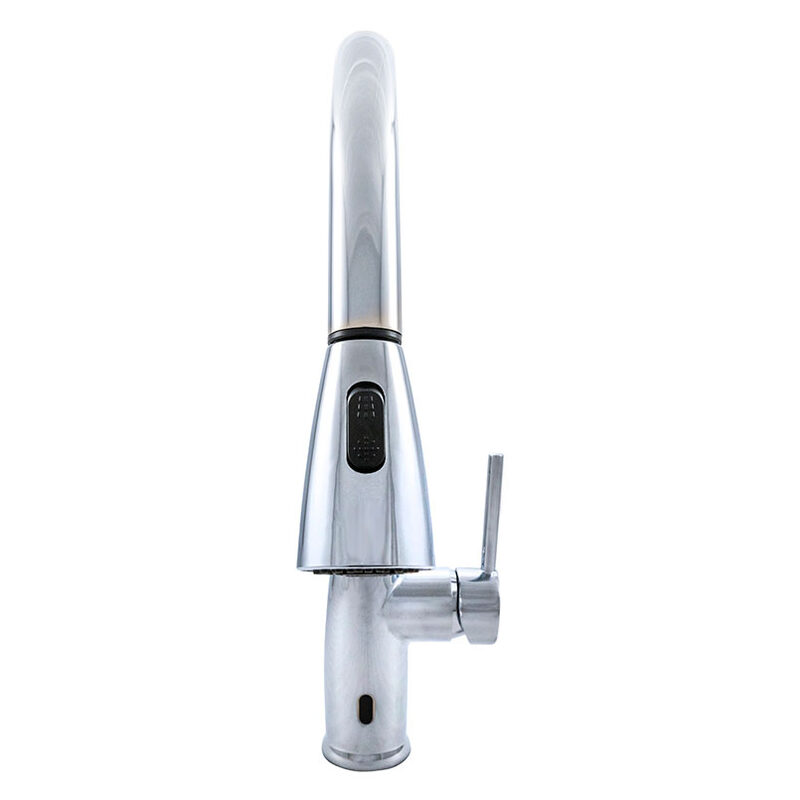
Details
- Material
- Metal
Templated, fabricated, and installed by our own crew across the northwest suburbs.
How we do sink & faucet installation →
Free in-home quoteSpecs
What is on the spec sheet — nothing inferred.
- Material
- Metal
- Activation
- Touchless infrared sensor
- Fixture type
- Kitchen
- Finish
- Polished chrome
- Model
- 812
In real rooms
3 rooms photographed with this surface.
These are the surface maker's room photos, not Ace jobs — they are the honest way to show a colour in daylight before you have seen a slab. We will show you ours in person, and the slab itself before we cut it.

In a kitchen 
In a kitchen 
In a kitchen
How it gets into your kitchen
7 steps, 14–42 days end to end.
Choose material and get quotes
Shortlist materials, visit a showroom or slab yard, and get an itemized quote: material, fabrication, edge profile, cutouts, tear-out, template fee. Selection pace is the homeowner's to control — a few days to two weeks is typical.
Tip: Rough tape-measure dimensions within an inch are fine for quoting; the fabricator laser-measures before anything is cut. Take samples home and look at them in your own morning and evening light before committing.
Lock in sink, faucet, and cooktop before template day
Every cutout and faucet hole is cut at the shop from exact specifications, so the sink, faucet (including soap dispenser or filter taps), and cooktop models must be final before templating. An undermount sink usually needs to be physically on site at the template appointment.
Tip: This is the deadline that ambushes people. Changing the sink or cooktop after templating typically adds 1-3 weeks of re-fabrication. Buy the sink early and keep the spec sheets handy.
Template appointment
The fabricator laser-measures or physically templates the installed cabinets and walls — capturing out-of-square corners and bowed walls the stone must be scribed to. Takes 1-2 hours. Cabinets must be set, level, and permanent; seam locations and overhangs are agreed on the spot.
Tip: Be home for this one. Decisions made at template (seam placement, overhang depth, backsplash height) are cut in stone — literally.
Fabrication at the shop
Slab is cut, cutouts made, edges profiled, and surfaces polished. Typical shops run 1-3 weeks; imported or exotic material can run 4-8 weeks. Fall pre-holiday rush and spring-summer peak stretch queues.
Tip: This is the quiet gap where nothing seems to happen at your house. If timing matters (holiday, listing), ask for the shop's current queue length before signing — it changes by season.
Tear-out and prep
Old tops come off, plumbing is disconnected, cabinets are checked level and shimmed. Often done the morning of install day; complex tear-outs (tile-over-mortar tops) can take a full day.
Tip: Clear the counters and empty the sink base cabinet the night before. Expect the water to the kitchen to be off from now until reconnection.
Installation day
Slabs are set, seams joined and color-matched, sink mounted, cooktop cutout fitted. Typically 4-6 hours; large or multi-seam kitchens can run a second day.
Tip: Plan dinner out. Keep pets and kids clear — crews are moving several-hundred-pound slabs through your doorways.
Reconnect plumbing and let adhesives cure
Silicone and seam epoxy cure 24-48 hours before the sink returns to service and heavy loads go on the tops. Faucet and disposal hookup is often a separate plumber visit the next day.
Tip: Do not mount the faucet, load the dishwasher against the new top, or stand mixer-anything on the counters until the cure window passes. Ask who reconnects plumbing — fabricators often do not.
What it costs installed
Published benchmark ranges, so you can sanity-check any quote — including ours.
| Line item | Typical range | Unit | As of |
|---|---|---|---|
| Faucet/accessory hole drilled in stone countertop | $65–$120 | per hole | 2026-07 |
| Kitchen faucet installation (labor and minor parts) | $80–$600 | per project | 2026-02 |
| Sink or faucet cutout in stone countertop | $100–$500 | per cutout | 2025-01 |
Regional benchmarks for the Chicago market — not an Ace quote. Your number depends on square footage, edge, cutouts and tear-out.
Sources: SlabWise; NearbyHunt, 2026; Granite Selection (Chicago-area fabricator), 2025; SlabWise, 2026
Similar surfaces
Same family — worth seeing side by side before you commit.

1-Handle 1-Spray Tub & Shower Faucet 608 with Pressure Balance Valve, Brushed Nickel
MetalBrushed

1-Handle 1-Spray Tub & Shower Faucet 608 with Pressure Balance Valve, Gold
MetalGold

1-Handle Bathroom Faucet 401, Chrome
Metal
1-Handle Bathroom Faucet 406, Chrome
Metal
1-Handle Bathroom Faucet, Brushed Nickel
MetalBrushed

1-Handle Bathroom Faucet, Gold
MetalGold
Questions about this surface
Do my cabinet pulls have to match my faucet and light fixtures?
No — designers deliberately mix metals, and a contrasting hardware finish is one of the cheapest ways to make a kitchen look intentionally designed. The working rules: keep it to two or three finishes total, make one clearly dominant (roughly 70 percent of the visible metal), and pair a warm metal with a cool one — brass with matte black, or polished nickel with oil-rubbed bronze. What to avoid is two finishes that almost match, like brushed nickel next to brushed chrome; that reads as a mistake rather than a choice.
How many faucet holes should I have drilled in my new countertop?
Count every deck item before fabrication: the faucet (one hole for most single-handle models, two at 8 in centers for a bridge), soap dispenser, dishwasher air gap where local plumbing practice requires one, and any filtered-water or instant-hot tap. Each hole costs roughly $65-$120 drilled at the shop; adding one to installed stone later is risky and many fabricators refuse the job. If you are unsure about a future accessory, drilling the extra hole now and capping it is far cheaper than wishing for it later.
Is a touchless kitchen faucet worth it, and what are the downsides?
Touchless faucets genuinely help when your hands are covered in flour or raw chicken - a wave starts the water, which cuts cross-contamination and keeps the handle smudge-free. The honest costs: a premium over the same faucet in manual form, a control box under the sink powered by batteries (commonly AA cells lasting one to two years) or an AC adapter, and electronics that can fail outside warranty. Buy a model with a full manual handle override so the sink still works normally if the sensor dies, and keep spare batteries on hand.
There is a cloudy white crust around my faucet that will not wash off. What is it and what removes it safely?
That is hard-water mineral deposit (limescale), not a stain in the quartz — and with the notoriously hard groundwater across Illinois, Wisconsin, and Indiana, nearly every kitchen gets it. Safe removal: a nonabrasive cleaner like a soft-scrub gel on a damp cloth, or a 50/50 white vinegar and water solution applied briefly — no more than a couple of minutes — then rinsed thoroughly and dried, since acid left sitting will dull quartz resin. Skip razor blades, scouring powder, and steel wool. Prevention is unglamorous but effective: dry the area around the faucet after use instead of letting water evaporate there.
Words that show up on a quote
Sixteen terms fabricators use as if everyone knows them.
- Mohs hardness
- A 1-10 mineral hardness scale used to compare countertop scratch resistance. Marble sits around 3-4 (scratches easily), granite 6-7, quartz and quartzite about 7, porcelain 7-8. A steel knife blade is roughly 5.5 — materials above that resist kitchen-knife scratches.
- Apron-front sink
- Also called a farmhouse sink: a deep bowl whose front face is exposed, replacing a strip of the cabinet front. Requires a modified, reinforced sink base - fireclay and cast iron versions commonly weigh 100-200 lb - and a countertop cut that wraps three sides of the bowl instead of a simple oval.
- Arris
- The sharp line where two surfaces of a countertop meet, such as the top and the edge face. Easing the arris means softening that line slightly so it resists chipping and feels smooth.
- Dolomitic marble
- A calcium-magnesium stone frequently sold as "soft quartzite" or under names like "super white." It looks like quartzite but etches and scratches like marble. Verify any quartzite purchase with a lemon-juice test on a sample: true quartzite will not etch.
- Edge grain
- Butcher-block construction where boards are glued with their long edges up, showing parallel strips of grain. More stable and affordable than end grain (the checkerboard of growth rings used on chopping blocks) and the standard construction for wood countertops.
- Edge profile
- The shape a fabricator grinds and polishes into the exposed front edge of a countertop - from a plain eased square to decorative curves like ogee. It affects style, chip resistance, cleaning effort, and price.
- Engineered quartz
- A factory-made slab of roughly 90% ground natural quartz mineral bound with ~10% polymer resin and pigments. Non-porous and never needs sealing, but the resin limits heat and UV tolerance. Sold under brands like Cambria, Silestone, Caesarstone, and LG Viatera.
- Etching
- A dull, slightly rough mark left when acid (lemon, vinegar, wine, some cleaners) chemically dissolves the polished surface of a calcium-based stone like marble. Etching is not a stain: sealer cannot prevent it, and removing it requires re-polishing the stone.
- Laminated edge
- An edge thickened by gluing a second strip of matching stone flat beneath the front edge, doubling the apparent slab thickness; the glue line remains visible on the edge face.
- Mitered edge
- An edge built from two stone pieces each cut at 45 degrees and epoxied so the seam hides at the corner, making thin stone read as a much thicker slab.
- Ogee
- An S-shaped decorative edge profile: a concave sweep on top flowing into a convex curve below. A classic choice for traditional and formal kitchens.
- Sink gauge
- The thickness of the steel in a stainless sink; lower numbers mean thicker metal. 16 gauge is about 0.063 in (1.59 mm) and resists dents and noise best; 18 gauge is about 0.047 in (1.2 mm) and is the value standard for residential bowls. Thinner than 18 gauge, flex and drumming become noticeable.
- Sink reveal
- The amount of sink rim left visible at an undermount cutout. A positive reveal leaves a sliver of rim showing (forgiving to fabricate, the common default); a zero or flush reveal aligns counter and bowl edges exactly (precision work that costs more); a negative reveal overhangs the bowl (sleek, but the thin lip can chip and the hidden rim traps grime). The reveal is set permanently when the countertop is cut.
- Sintered stone
- A slab made by compacting mineral powders and clays under extreme pressure and heat ("sintering") until the particles fuse — no resin binder. Heat-proof, UV-stable, and non-porous; Dekton and Neolith are the best-known brands. Often grouped with porcelain slab countertops.
- Stone sealer
- A penetrating liquid applied to porous natural stone (granite, quartzite, marble) and concrete that slows liquid absorption so spills can be wiped before they stain. Wears off with use — most stones need resealing every 6-24 months. A quick test: if water stops beading and starts darkening the stone, it is time.
- Waterfall edge
- A countertop treatment where the surface turns 90 degrees and continues down the side of an island or cabinet run to the floor, usually with mitered, book-matched corners.
Want this in your kitchen?
We supply and install Touchless Infrared Sensor Kitchen Faucet 812, Chrome out of our Elk Grove Village shop — templated digitally, cut to your cabinets, installed by our own crew.
Ready for a real number?
Free in-home template and an honest quote — you keep your money until there's a countertop to trade it for.