
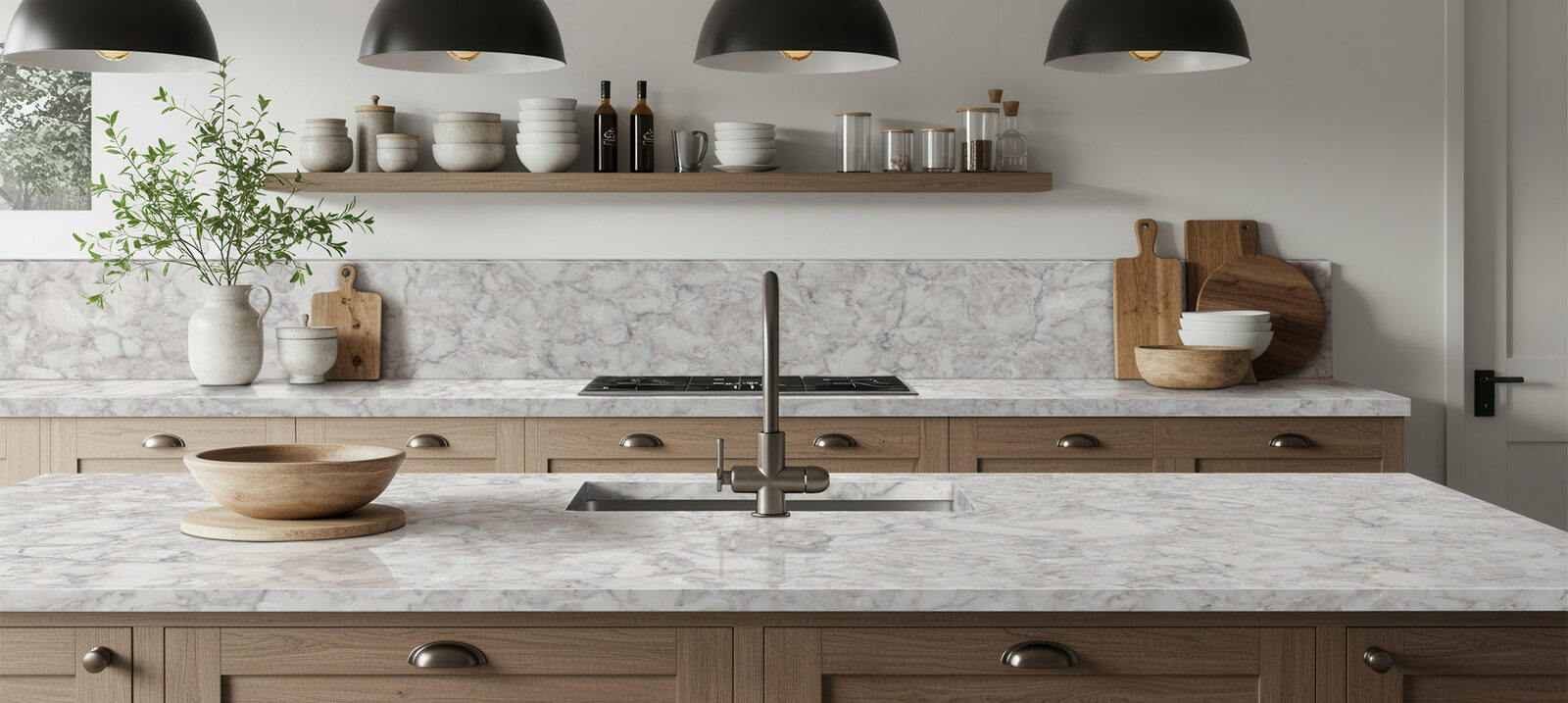
Quartz Countertops
Low-maintenance engineered quartz in every look from crisp white to deep-veined marble-alike.
Where we install
Fabricated in Elk Grove Village, installed across the northwest suburbs.
What this service covers
And, just as usefully, what it does not.
Low-maintenance engineered quartz in every look from crisp white to deep-veined marble-alike.
What we do
- Template appointment — The fabricator laser-measures or physically templates the installed cabinets and walls — capturing out-of-square corners and bowed walls the stone must be scribed to. Takes 1-2 hours. Cabinets must be set, level, and permanent; seam locations and overhangs are agreed on the spot.
- Fabrication at the shop — Slab is cut, cutouts made, edges profiled, and surfaces polished. Typical shops run 1-3 weeks; imported or exotic material can run 4-8 weeks. Fall pre-holiday rush and spring-summer peak stretch queues.
- Tear-out and prep — Old tops come off, plumbing is disconnected, cabinets are checked level and shimmed. Often done the morning of install day; complex tear-outs (tile-over-mortar tops) can take a full day.
- Installation day — Slabs are set, seams joined and color-matched, sink mounted, cooktop cutout fitted. Typically 4-6 hours; large or multi-seam kitchens can run a second day.
- Reconnect plumbing and let adhesives cure — Silicone and seam epoxy cure 24-48 hours before the sink returns to service and heavy loads go on the tops. Faucet and disposal hookup is often a separate plumber visit the next day.
What stays on your side
- Choose material and get quotes — Shortlist materials, visit a showroom or slab yard, and get an itemized quote: material, fabrication, edge profile, cutouts, tear-out, template fee. Selection pace is the homeowner's to control — a few days to two weeks is typical.
- Lock in sink, faucet, and cooktop before template day — Every cutout and faucet hole is cut at the shop from exact specifications, so the sink, faucet (including soap dispenser or filter taps), and cooktop models must be final before templating. An undermount sink usually needs to be physically on site at the template appointment.
Not in this quote
- Cabinet repair or replacement, and any cabinet levelling beyond shimming for the new top.
- Electrical and gas work; licensed plumbing beyond disconnecting and reconnecting the sink and faucet.
- Municipal permits — countertop-only swaps are usually cosmetic, but permitting is home-rule and varies suburb to suburb.
- Drywall repair, painting, and flooring changes behind or below the work.
How it goes, step by step
7 steps · 9.6–46.2 days from first call to finished counter.
Choose material and get quotes
Shortlist materials, visit a showroom or slab yard, and get an itemized quote: material, fabrication, edge profile, cutouts, tear-out, template fee. Selection pace is the homeowner's to control — a few days to two weeks is typical.
Tip: Rough tape-measure dimensions within an inch are fine for quoting; the fabricator laser-measures before anything is cut. Take samples home and look at them in your own morning and evening light before committing.
Lock in sink, faucet, and cooktop before template day
Every cutout and faucet hole is cut at the shop from exact specifications, so the sink, faucet (including soap dispenser or filter taps), and cooktop models must be final before templating. An undermount sink usually needs to be physically on site at the template appointment.
Tip: This is the deadline that ambushes people. Changing the sink or cooktop after templating typically adds 1-3 weeks of re-fabrication. Buy the sink early and keep the spec sheets handy.
Template appointment
The fabricator laser-measures or physically templates the installed cabinets and walls — capturing out-of-square corners and bowed walls the stone must be scribed to. Takes 1-2 hours. Cabinets must be set, level, and permanent; seam locations and overhangs are agreed on the spot.
Tip: Be home for this one. Decisions made at template (seam placement, overhang depth, backsplash height) are cut in stone — literally.
Fabrication at the shop
Slab is cut, cutouts made, edges profiled, and surfaces polished. Typical shops run 1-3 weeks; imported or exotic material can run 4-8 weeks. Fall pre-holiday rush and spring-summer peak stretch queues.
Tip: This is the quiet gap where nothing seems to happen at your house. If timing matters (holiday, listing), ask for the shop's current queue length before signing — it changes by season.
Tear-out and prep
Old tops come off, plumbing is disconnected, cabinets are checked level and shimmed. Often done the morning of install day; complex tear-outs (tile-over-mortar tops) can take a full day.
Tip: Clear the counters and empty the sink base cabinet the night before. Expect the water to the kitchen to be off from now until reconnection.
Installation day
Slabs are set, seams joined and color-matched, sink mounted, cooktop cutout fitted. Typically 4-6 hours; large or multi-seam kitchens can run a second day.
Tip: Plan dinner out. Keep pets and kids clear — crews are moving several-hundred-pound slabs through your doorways.
Reconnect plumbing and let adhesives cure
Silicone and seam epoxy cure 24-48 hours before the sink returns to service and heavy loads go on the tops. Faucet and disposal hookup is often a separate plumber visit the next day.
Tip: Do not mount the faucet, load the dishwasher against the new top, or stand mixer-anything on the counters until the cure window passes. Ask who reconnects plumbing — fabricators often do not.
What it costs
Ace's installed ranges by kitchen size, plus benchmark costs for common add-ons.
| Kitchen size | Engineered Quartz | Granite | Quartzite |
|---|---|---|---|
| Galley kitchens (30–45 sqft) | $3,600–$6,750 | $4,200–$7,650 | $4,500–$8,550 |
| Small kitchens (45–60 sqft) | $5,400–$9,000 | $6,300–$10,200 | $6,750–$11,400 |
| Medium kitchens (60–75 sqft) | $7,200–$11,250 | $8,400–$12,750 | $9,000–$14,250 |
| Large kitchens (75–90 sqft) | $9,000–$13,500 | $10,500–$15,300 | $11,250–$17,100 |
| Extra large kitchens (90–120 sqft) | $10,800–$18,000 | $12,600–$20,400 | $13,500–$22,800 |
Installed project ranges as of 2026-07 — template, fabrication and standard installation included. Your exact number comes from a free in-home template.
Extras & line items
| Line item | Typical range | Unit | As of |
|---|---|---|---|
| Quartz countertop installed | $50–$120 | per sq ft | 2026-07 |
| Quartz countertop slab material only | $15–$50 | per sq ft | 2025-09 |
| Quartz slab backsplash, installed | $50–$120 | per sq ft | 2026-06 |
| Quartz slab material only | $50–$200 | per sq ft | 2025-01 |
| Sink cutout | $150–$400 | per cutout | 2026-07 |
Chicago-market benchmarks for common add-ons — not an Ace quote; your number depends on square footage, edge profile, cutouts and tear-out.
Materials we work with
Price tier, care level and independent durability ratings, side by side.
| Material | Price tier | Care | Heat | Scratch | Stain | Etch |
|---|---|---|---|---|---|---|
| Quartz | Mid | Low | 2/5 | 4/5 | 5/5 | 4/5 |
| Granite | Mid | Medium | 4/5 | 4/5 | 4/5 | 4/5 |
| Quartzite | Premium | Medium | 5/5 | 5/5 | 3/5 | 4/5 |
| Porcelain slab | Mid | Low | 5/5 | 5/5 | 5/5 | 5/5 |
| Solid surface | Mid | Low | 2/5 | 2/5 | 4/5 | 3/5 |
Durability 1–5, higher is better. Ratings are independent, not manufacturer marketing.
The honest trade-offs
- Quartz — Nonporous, never needs sealing, excellent stain resistance, consistent repeatable patterns, easy soap-and-water care Trade-off: Resin binder scorches or discolors around 300F so hot pans are off-limits; heat damage excluded from manufacturer warranties; not UV-stable for outdoor use; seams visible on light solids
- Granite — Tolerates hot cookware; every slab unique; excellent scratch resistance; decades-long service life Trade-off: Porous — some stones benefit from periodic sealing; can chip at edges and sink corners; pattern variation makes seam matching harder
- Quartzite — Harder than granite; takes hot pans; marble look without marble softness; one-of-a-kind slabs Trade-off: Needs sealing; premium price; some stone sold as quartzite is softer marble-family rock — verify with scratch/acid test; limited color range vs quartz
- Porcelain slab — Thin, very heat- and UV-stable; works as counters and full-height backsplashes Trade-off: Edges can chip on impact; pattern is often printed on the surface rather than through the body
- Solid surface — Seams fuse invisibly; integrated sinks and coved backsplashes possible (health-inspector friendly); scratches sand out Trade-off: Scratches and scorches more easily than stone; reads less premium at resale; mid pricing overlaps entry stone
Mistakes that cost people money
Every one of these shows up on jobs we get called in to fix.
Cleaning natural stone with vinegar, lemon, or "daily shower" acidic sprays
What it costs you: Acids etch marble, limestone, and travertine on contact (permanent dull marks) and strip the sealer from granite and quartzite ahead of schedule.
How to avoid it: Use pH-neutral stone cleaner, stone soap, or mild dish soap in warm water; keep the vinegar spray for windows.
Already done it? Light etching on polished stone buffs out with marble polishing powder; widespread dullness needs professional re-honing and a fresh coat of penetrating sealer.
Designing an island seating overhang after the cabinets are already set
What it costs you: A 10-inch overhang looks like seating but knees do not fit; pushing past 10-12 inches unsupported on 3cm quartz or granite (about 6 inches on 2cm, and 6-10 inches for marble) risks flexing and cracking under elbows and leaning.
How to avoid it: Plan 12-15 inches of overhang for dining during design, allow about 24 inches of width per seat, and specify brackets, corbels, or steel supports whenever the overhang exceeds 10-12 inches or more than a third of the top hangs unsupported.
Already done it? Retrofit low-profile steel brackets or corbels under the existing overhang - far cheaper than replacing a cracked slab.
Paying to have quartz countertops "sealed" every year
What it costs you: Sealer cannot penetrate non-porous quartz; it dries on the surface as a film that dulls the gloss unevenly and attracts grime.
How to avoid it: Skip sealing entirely — every major quartz brand states no sealing or polishing is ever required.
Already done it? Sealer residue usually needs careful stripping (often professional) to restore an even factory sheen.
Setting hot cookware and countertop appliances directly on quartz
What it costs you: The resin binding engineered quartz starts degrading around 300 degrees F - pans off a burner run 400-500 degrees F - leaving white rings, yellow-brown scorch, or hairline thermal cracks; manufacturers exclude heat damage from warranties.
How to avoid it: Keep trivets where you cook, and put a board or heat pad under slow cookers, air fryers, and toaster ovens that run hot for hours in one spot.
Already done it? Light surface marks can sometimes be improved by professional polishing; deep scorch or cracking means a patch or section replacement - prevention is the only cheap option.
How long it takes
9.6–46.2 days in total — most of it is fabrication, not install day.
| Stage | Typical duration | Who |
|---|---|---|
| Choose material and get quotes | 2–14 days | Homeowner |
| Lock in sink, faucet, and cooktop before template day | 1–7 days | Homeowner |
| Template appointment | 0.1–5 hr | Fabricator |
| Fabrication at the shop | 5–21 days | Fabricator |
| Tear-out and prep | 0.3–1 day | Contractor |
| Installation day | 0.3–1 day | Fabricator |
| Reconnect plumbing and let adhesives cure | 1–2 days | Contractor |
Calendar days, not working hours. Slab availability is the usual variable.
Warranty
Manufacturer Surface Warranty
- Covers
- Materials
- Duration
- Up to lifetime
Engineered-quartz surfaces carry manufacturer warranties up to a lifetime residential term; we register yours.
Questions about quartz countertops
Are recycled-glass countertops as durable as regular quartz?
Resin-bound recycled-glass surfaces behave much like engineered quartz: non-porous, stain-resistant, and never in need of sealing. Cement-bound versions are closer to polished concrete — they want periodic sealing and their edges can chip under impact. Neither type tolerates hot pans directly. The bigger practical issue in Illinois, Wisconsin, and Indiana is availability: fewer fabricators stock recycled glass, so compare warranties and local service before committing, and note that recycled-content quartz lines from major brands can deliver similar green credentials with easier sourcing.
Can I put a hot pan on a quartz countertop?
No — and this is the single most common regret reported by quartz owners. The stone content is heat-tolerant but the resin binder is not: Caesarstone’s own guidance says the resin withstands only about 150C/300F, that cookware straight from the oven "will burn the countertop," and that even moderately hot pots left sitting can discolor the surface. The resulting brown or yellow scorch ring is a resin burn that professionals can sometimes — not always — polish out, and virtually every manufacturer (Caesarstone, Cambria, Silestone) excludes heat damage from warranty. Keep trivets within arm’s reach of the range; the habit matters more than the material.
Can I set a hot pan directly on my quartz countertop?
No — this is quartz's one real weakness. The stone content can take the heat, but the ~10% polymer resin that binds it can scorch, discolor, or even crack from pans in the 300 F+ range, and heat damage is typically excluded from brand warranties. Keep trivets by the stove; if trivet discipline is not realistic in your house, choose granite, quartzite, or porcelain instead.
Can I set hot pans directly on granite or quartz?
Granite tolerates brief contact with hot cookware better than almost any counter, but repeated heat can degrade the sealer and a very hot pan on a cold slab risks thermal shock — so a trivet is still the smart habit. Quartz is a harder no: its resin binder scorches and can crack from sudden temperature change, and manufacturers explicitly exclude heat damage from their warranties. One trivet by the stove protects a four-figure counter; it is not a hard trade.
Do buyers around here care whether my counters are quartz, granite, or laminate?
They care, but less than the condition of the whole room. Zillow listing analysis found homes mentioning quartzite sold about 5.3% above expectations and quartz about 3% - yet the minor-remodel spec that recoups the most in Cost vs. Value uses laminate counters. In most Illinois, Wisconsin, and Indiana mid-market listings, quartz or granite is the expected standard for an updated kitchen, and going a tier above your neighborhood rarely returns the difference. Clean, current, and consistent with nearby comps beats material one-upmanship.
Do my quartz countertops need to be sealed every year?
No — never. Quartz is non-porous, and every major manufacturer says the same thing: sealers cannot penetrate it, so they sit on top, wear unevenly, and leave the gloss dull or streaky. If a service company offers annual quartz sealing, decline; the only routine care quartz needs is warm water, mild soap, and a trivet under anything hot.
Ready for a real number?
One visit, one number, no end-of-job surprises. We template digitally and fabricate in our own Elk Grove Village shop.
Ready for a real number?
Free in-home template and an honest quote — you keep your money until there's a countertop to trade it for.