
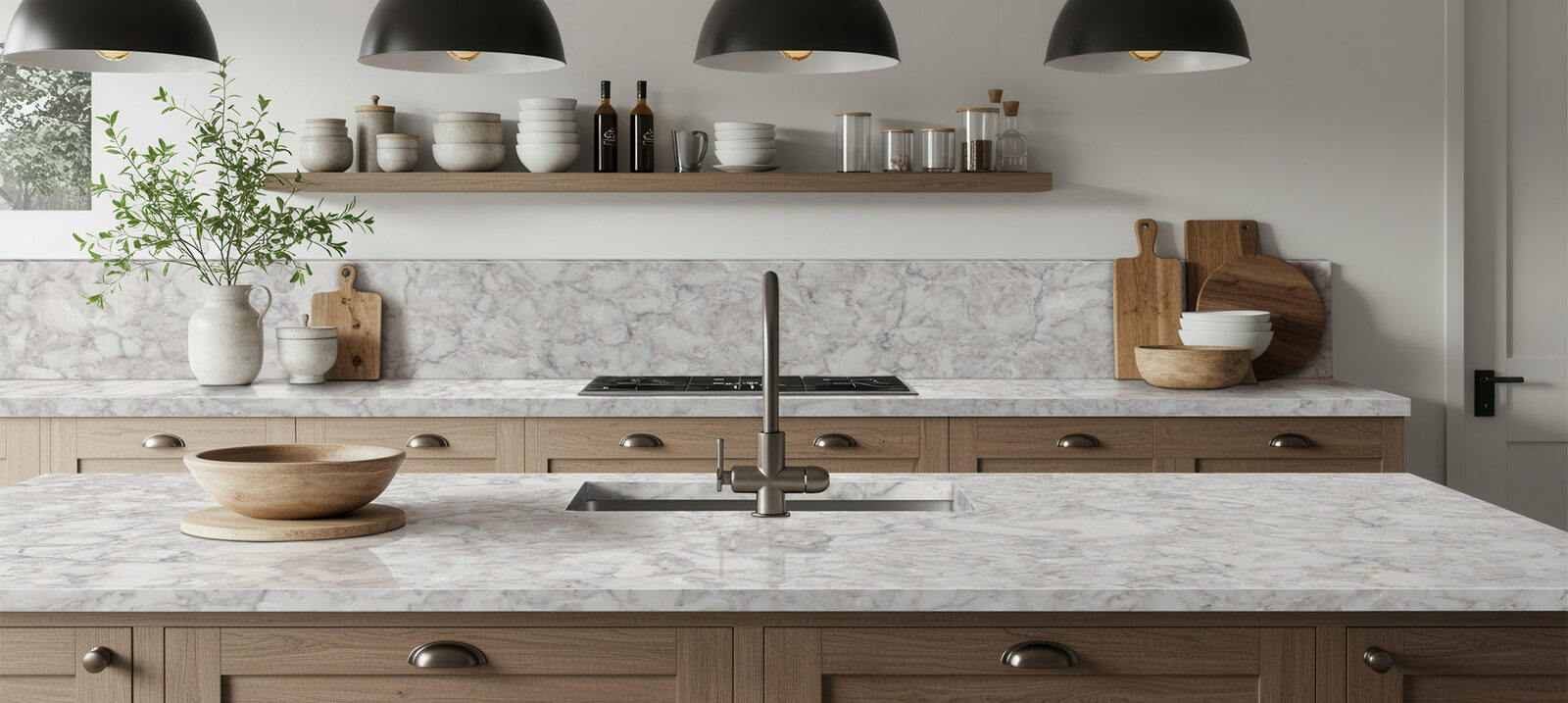
Countertop Fabrication
We cut, profile, and polish your slab in-house so the piece that shows up is the piece we made for your kitchen.
Where we install
Fabricated in Elk Grove Village, installed across the northwest suburbs.
What this service covers
And, just as usefully, what it does not.
We cut, profile, and polish your slab in-house so the piece that shows up is the piece we made for your kitchen.
What we do
- Template appointment — The fabricator laser-measures or physically templates the installed cabinets and walls — capturing out-of-square corners and bowed walls the stone must be scribed to. Takes 1-2 hours. Cabinets must be set, level, and permanent; seam locations and overhangs are agreed on the spot.
- Fabrication at the shop — Slab is cut, cutouts made, edges profiled, and surfaces polished. Typical shops run 1-3 weeks; imported or exotic material can run 4-8 weeks. Fall pre-holiday rush and spring-summer peak stretch queues.
- Tear-out and prep — Old tops come off, plumbing is disconnected, cabinets are checked level and shimmed. Often done the morning of install day; complex tear-outs (tile-over-mortar tops) can take a full day.
What stays on your side
- Lock in sink, faucet, and cooktop before template day — Every cutout and faucet hole is cut at the shop from exact specifications, so the sink, faucet (including soap dispenser or filter taps), and cooktop models must be final before templating. An undermount sink usually needs to be physically on site at the template appointment.
Not in this quote
- Cabinet repair or replacement, and any cabinet levelling beyond shimming for the new top.
- Electrical and gas work; licensed plumbing beyond disconnecting and reconnecting the sink and faucet.
- Municipal permits — countertop-only swaps are usually cosmetic, but permitting is home-rule and varies suburb to suburb.
- Drywall repair, painting, and flooring changes behind or below the work.
How it goes, step by step
4 steps · 6.3–29.2 days from first call to finished counter.
Lock in sink, faucet, and cooktop before template day
Every cutout and faucet hole is cut at the shop from exact specifications, so the sink, faucet (including soap dispenser or filter taps), and cooktop models must be final before templating. An undermount sink usually needs to be physically on site at the template appointment.
Tip: This is the deadline that ambushes people. Changing the sink or cooktop after templating typically adds 1-3 weeks of re-fabrication. Buy the sink early and keep the spec sheets handy.
Template appointment
The fabricator laser-measures or physically templates the installed cabinets and walls — capturing out-of-square corners and bowed walls the stone must be scribed to. Takes 1-2 hours. Cabinets must be set, level, and permanent; seam locations and overhangs are agreed on the spot.
Tip: Be home for this one. Decisions made at template (seam placement, overhang depth, backsplash height) are cut in stone — literally.
Fabrication at the shop
Slab is cut, cutouts made, edges profiled, and surfaces polished. Typical shops run 1-3 weeks; imported or exotic material can run 4-8 weeks. Fall pre-holiday rush and spring-summer peak stretch queues.
Tip: This is the quiet gap where nothing seems to happen at your house. If timing matters (holiday, listing), ask for the shop's current queue length before signing — it changes by season.
Tear-out and prep
Old tops come off, plumbing is disconnected, cabinets are checked level and shimmed. Often done the morning of install day; complex tear-outs (tile-over-mortar tops) can take a full day.
Tip: Clear the counters and empty the sink base cabinet the night before. Expect the water to the kitchen to be off from now until reconnection.
What it costs
Ace's installed ranges by kitchen size, plus benchmark costs for common add-ons.
| Kitchen size | Engineered Quartz | Granite | Quartzite | Marble |
|---|---|---|---|---|
| Galley kitchens (30–45 sqft) | $3,600–$6,750 | $4,200–$7,650 | $4,500–$8,550 | $5,100–$9,000 |
| Small kitchens (45–60 sqft) | $5,400–$9,000 | $6,300–$10,200 | $6,750–$11,400 | $7,650–$12,000 |
| Medium kitchens (60–75 sqft) | $7,200–$11,250 | $8,400–$12,750 | $9,000–$14,250 | $10,200–$15,000 |
| Large kitchens (75–90 sqft) | $9,000–$13,500 | $10,500–$15,300 | $11,250–$17,100 | $12,750–$18,000 |
| Extra large kitchens (90–120 sqft) | $10,800–$18,000 | $12,600–$20,400 | $13,500–$22,800 | $15,300–$24,000 |
Installed project ranges as of 2026-07 — template, fabrication and standard installation included. Your exact number comes from a free in-home template.
Extras & line items
| Line item | Typical range | Unit | As of |
|---|---|---|---|
| Faucet/accessory hole drilled in stone countertop | $65–$120 | per hole | 2026-07 |
| Countertop edge upgrade: mid-range profiles (full bullnose, ogee, cove) | $12–$20 | per linear ft | 2026-05 |
| Countertop edge upgrade: premium profiles (DuPont, chiseled, laminated, triple pencil, mitered) | $20–$35 | per linear ft | 2026-05 |
| Countertop edge upgrade: simple profiles (wide bevel, pencil round, half/demi bullnose) | $5–$12 | per linear ft | 2026-05 |
| Countertop fabrication and installation labor | $20–$50 | per sq ft | 2025-01 |
| Edge profile upgrade (ogee, bullnose, beveled) | $5–$40 | per linear ft | 2026-07 |
| Sink cutout | $150–$400 | per cutout | 2026-07 |
Chicago-market benchmarks for common add-ons — not an Ace quote; your number depends on square footage, edge profile, cutouts and tear-out.
Materials we work with
Price tier, care level and independent durability ratings, side by side.
| Material | Price tier | Care | Heat | Scratch | Stain | Etch |
|---|---|---|---|---|---|---|
| Quartz | Mid | Low | 2/5 | 4/5 | 5/5 | 4/5 |
| Granite | Mid | Medium | 4/5 | 4/5 | 4/5 | 4/5 |
| Quartzite | Premium | Medium | 5/5 | 5/5 | 3/5 | 4/5 |
| Marble | Premium | High | 4/5 | 2/5 | 2/5 | 1/5 |
| Porcelain slab | Mid | Low | 5/5 | 5/5 | 5/5 | 5/5 |
Durability 1–5, higher is better. Ratings are independent, not manufacturer marketing.
The honest trade-offs
- Quartz — Nonporous, never needs sealing, excellent stain resistance, consistent repeatable patterns, easy soap-and-water care Trade-off: Resin binder scorches or discolors around 300F so hot pans are off-limits; heat damage excluded from manufacturer warranties; not UV-stable for outdoor use; seams visible on light solids
- Granite — Tolerates hot cookware; every slab unique; excellent scratch resistance; decades-long service life Trade-off: Porous — some stones benefit from periodic sealing; can chip at edges and sink corners; pattern variation makes seam matching harder
- Quartzite — Harder than granite; takes hot pans; marble look without marble softness; one-of-a-kind slabs Trade-off: Needs sealing; premium price; some stone sold as quartzite is softer marble-family rock — verify with scratch/acid test; limited color range vs quartz
- Marble — Classic look; naturally cool surface prized by bakers; ages into a patina many owners love; honed finishes hide wear well Trade-off: Etches on contact with acids (lemon, wine, tomato) — no sealer prevents it; softer and more scratch/chip-prone than granite; stains if unsealed and neglected
- Porcelain slab — Thin, very heat- and UV-stable; works as counters and full-height backsplashes Trade-off: Edges can chip on impact; pattern is often printed on the surface rather than through the body
Mistakes that cost people money
Every one of these shows up on jobs we get called in to fix.
Attempting a DIY slab countertop install
What it costs you: Slab stone is heavy and brittle in the wrong axis: DIY moves crack slabs at sink cutouts, chip finished edges, and injure backs - and self-install usually voids the fabricator warranty.
How to avoid it: Let the fabricator crew template, carry, and set the stone; if you want DIY savings, take on demolition, painting, or the backsplash instead.
Already done it? Small chips can be epoxy-repaired by a stone pro; a crack across a cutout usually means re-fabricating that section.
Budgeting from the slab showroom price instead of an installed quote
What it costs you: Templating, fabrication, cutouts, edge work, transport, tearout, and reinforcement add substantially to the material price - sticker shock arrives with the first real quote.
How to avoid it: Get installed, itemized quotes from fabricators early and budget from those numbers; treat advertised per-square-foot prices as marketing.
Already done it? Trim an installed price by simplifying: fewer seams, a standard edge profile, a standard sink cutout, and keeping the existing layout.
Buying the sink after the countertop template appointment
What it costs you: Re-template fee of $75-$150, a week or more of schedule slip, or - if templating proceeded from a spec sheet - a cutout that does not match the actual sink, which cannot be fixed.
How to avoid it: Order the sink first and have it physically on site (with the faucet spec sheet) before template day; fireclay sinks can vary up to 2% from nominal dimensions.
Already done it? Pay the re-template fee and wait for a new appointment; never let a mismatched cutout be "made to work" with oversized caulk joints.
Calling the countertop fabricator only after the cabinets are finished
What it costs you: Fabricators book out weeks ahead; latecomers get rushed slab choices from whatever is in stock and can wait 2-6 weeks with a torn-up kitchen between cabinet work and countertop install.
How to avoid it: Start countertop conversations 1-3 months before your target install date, before cabinet decisions are final - a good fabricator flags layout problems (seams, overhangs, sink fit) while they are still cheap to change.
Already done it? Bridge the gap by loosely resetting the old tops or fitting a temporary plywood or laminate top so the sink and cooktop stay usable while you wait.
Choosing 2cm stone without planning for its limits
What it costs you: Thin 2cm tops need edge build-up to get the standard chunky look, tolerate only about 6 inches of unsupported overhang, and are less forgiving over uneven cabinets.
How to avoid it: In most Midwest markets 3cm is the kitchen standard; choose 2cm deliberately (weight, cost, thin modern look) with the fabricator support plan in writing.
Already done it? Add continuous plywood decking and brackets beneath 2cm tops to stiffen spans and overhangs.
Choosing natural stone from a 4-inch sample
What it costs you: Natural slabs vary widely - a quiet gray sample can come from a slab with bold sweeping veining, and the installed top looks nothing like what was approved.
How to avoid it: View and tag the actual slab before fabrication, and ask for a layout session showing where each cut lands relative to the sink, seams, and island.
Already done it? If the slab disappoints before cutting, most fabricators allow re-selection (sometimes with a fee); after cutting there is no undo.
How long it takes
6.3–29.2 days in total — most of it is fabrication, not install day.
| Stage | Typical duration | Who |
|---|---|---|
| Lock in sink, faucet, and cooktop before template day | 1–7 days | Homeowner |
| Template appointment | 0.1–5 hr | Fabricator |
| Fabrication at the shop | 5–21 days | Fabricator |
| Tear-out and prep | 0.3–1 day | Contractor |
Calendar days, not working hours. Slab availability is the usual variable.
Questions about countertop fabrication
Are countertops priced by the square foot or by the slab — and why does it matter?
Quotes are usually expressed per square foot, but stone is bought by the slab, and that mismatch explains several surprises. If your kitchen needs 55 sq ft and slabs run 50 sq ft, you are buying two slabs and paying for the waste — sometimes a small layout tweak that fits one slab saves four figures. It also makes vein placement a real decision: ask to see your countertop outlines laid over the actual slab before cutting, so the dramatic vein lands on the island rather than under the dish rack.
Are decorative edges like ogee harder to keep clean?
Modestly, yes. The concave channel in an ogee, cove, or DuPont profile traps crumbs, grease, and dried cleaning spray, so those edges need a deliberate detail wipe instead of one pass with a cloth. Eased, pencil, and bullnose edges clean in a single wipe, while a chiseled rock-face edge is the hardest of all because the rough texture holds dust. None of this is a dealbreaker - it is one extra wipe - but if you hate fussy cleaning, stay with a smooth, simple profile.
Are the dramatic veined slabs and waterfall islands all over Instagram practical in an ordinary Midwest kitchen?
They can be, but scale and budget both matter. A bold, heavily veined slab can overwhelm a small closed-off kitchen — many bungalow and ranch kitchens in the Midwest are compact, and a busy pattern reads much louder in person than in a wide-angle photo of a big open plan. Waterfall edges are also a genuine cost item, not just a style choice: the mitered corners and extra vertical stone typically add $1,000-$3,000 to an island as of mid-2026 fabricator pricing. In a smaller kitchen that money usually does more for you in a better material grade, better lighting, or an upgraded sink.
Do all my counters need the same edge profile?
No - mixing edges is standard practice, not a compromise. A common approach is a decorative or mitered edge on the island, where hands and eyes land, with a plain eased or pencil edge on the perimeter, which saves several hundred dollars and creates deliberate visual hierarchy. Just keep one profile per continuous run of countertop so the transition never happens mid-counter.
Does the edge profile really matter, and what does it cost?
The edge is the part your hands and hips touch every day, and it changes both style and price. A simple eased or pencil edge is usually included in the base price and suits most kitchens; decorative profiles like ogee or bullnose add $5-$40 per linear foot and read traditional; a mitered waterfall edge is the premium statement at $500-$2,000 per island side. One honest note from homeowner issue data: ornate multi-step edges chip more easily at overhangs and are much harder to repair invisibly than a simple eased edge.
Does using a local fabricator make my countertop more sustainable?
Modestly, and in ways worth having: shorter slab transport, the option to buy remnants for a vanity or laundry top instead of sending offcuts to the dumpster, and a shop you can actually visit to ask about water recycling and dust control. Be honest about the limits, though — the slab itself may have crossed an ocean before reaching the shop, and the production footprint of the material dwarfs the last fifty miles. The bigger sustainability lever is picking something durable that you will keep for decades.
Ready for a real number?
One visit, one number, no end-of-job surprises. We template digitally and fabricate in our own Elk Grove Village shop.
Ready for a real number?
Free in-home template and an honest quote — you keep your money until there's a countertop to trade it for.