
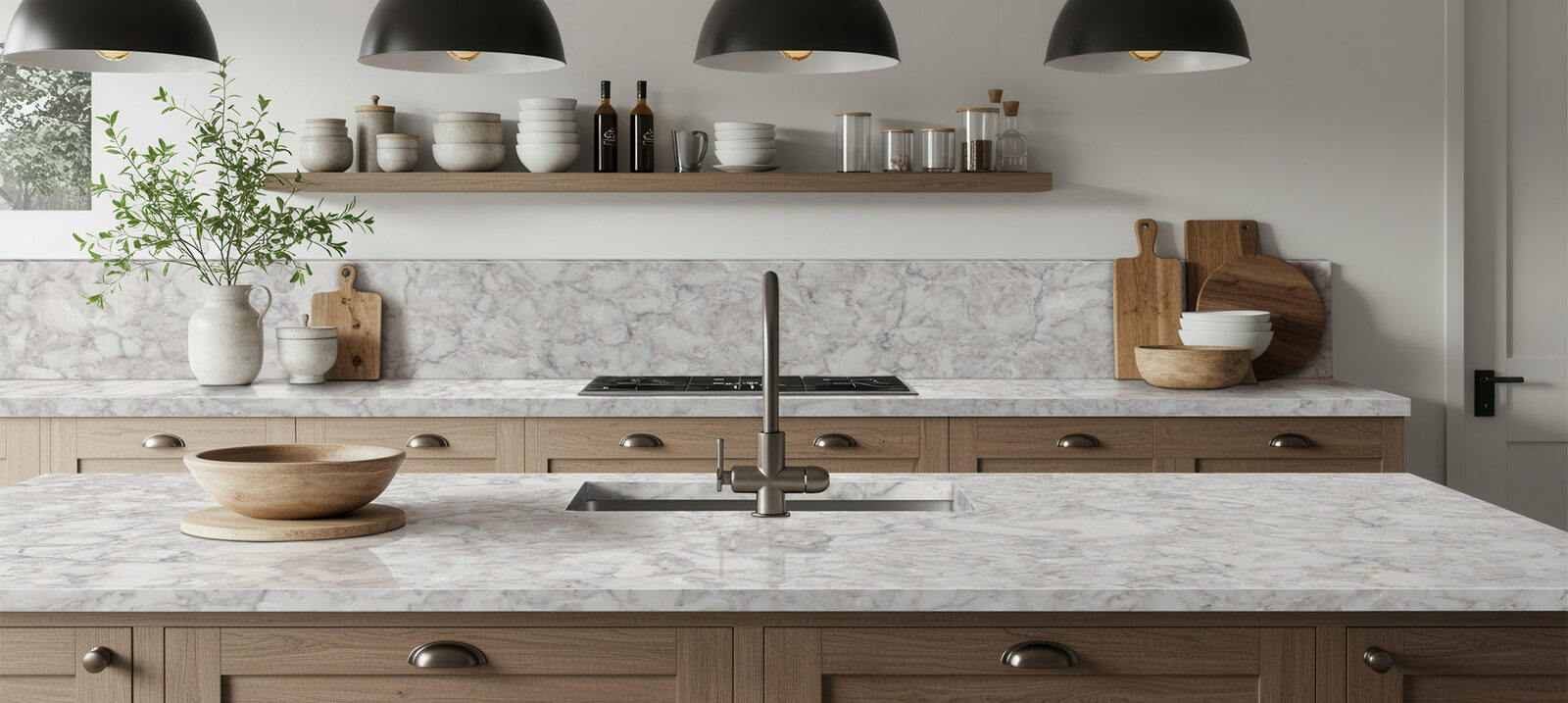
Marble & Quartzite Countertops
Show-stopping natural marble and hard-wearing quartzite for the kitchens that want the real thing.
Where we install
Fabricated in Elk Grove Village, installed across the northwest suburbs.
What this service covers
And, just as usefully, what it does not.
Show-stopping natural marble and hard-wearing quartzite for the kitchens that want the real thing.
What we do
- Template appointment — The fabricator laser-measures or physically templates the installed cabinets and walls — capturing out-of-square corners and bowed walls the stone must be scribed to. Takes 1-2 hours. Cabinets must be set, level, and permanent; seam locations and overhangs are agreed on the spot.
- Fabrication at the shop — Slab is cut, cutouts made, edges profiled, and surfaces polished. Typical shops run 1-3 weeks; imported or exotic material can run 4-8 weeks. Fall pre-holiday rush and spring-summer peak stretch queues.
- Tear-out and prep — Old tops come off, plumbing is disconnected, cabinets are checked level and shimmed. Often done the morning of install day; complex tear-outs (tile-over-mortar tops) can take a full day.
- Installation day — Slabs are set, seams joined and color-matched, sink mounted, cooktop cutout fitted. Typically 4-6 hours; large or multi-seam kitchens can run a second day.
- Reconnect plumbing and let adhesives cure — Silicone and seam epoxy cure 24-48 hours before the sink returns to service and heavy loads go on the tops. Faucet and disposal hookup is often a separate plumber visit the next day.
What stays on your side
- Choose material and get quotes — Shortlist materials, visit a showroom or slab yard, and get an itemized quote: material, fabrication, edge profile, cutouts, tear-out, template fee. Selection pace is the homeowner's to control — a few days to two weeks is typical.
- Lock in sink, faucet, and cooktop before template day — Every cutout and faucet hole is cut at the shop from exact specifications, so the sink, faucet (including soap dispenser or filter taps), and cooktop models must be final before templating. An undermount sink usually needs to be physically on site at the template appointment.
Not in this quote
- Cabinet repair or replacement, and any cabinet levelling beyond shimming for the new top.
- Electrical and gas work; licensed plumbing beyond disconnecting and reconnecting the sink and faucet.
- Municipal permits — countertop-only swaps are usually cosmetic, but permitting is home-rule and varies suburb to suburb.
- Drywall repair, painting, and flooring changes behind or below the work.
How it goes, step by step
7 steps · 9.6–46.2 days from first call to finished counter.
Choose material and get quotes
Shortlist materials, visit a showroom or slab yard, and get an itemized quote: material, fabrication, edge profile, cutouts, tear-out, template fee. Selection pace is the homeowner's to control — a few days to two weeks is typical.
Tip: Rough tape-measure dimensions within an inch are fine for quoting; the fabricator laser-measures before anything is cut. Take samples home and look at them in your own morning and evening light before committing.
Lock in sink, faucet, and cooktop before template day
Every cutout and faucet hole is cut at the shop from exact specifications, so the sink, faucet (including soap dispenser or filter taps), and cooktop models must be final before templating. An undermount sink usually needs to be physically on site at the template appointment.
Tip: This is the deadline that ambushes people. Changing the sink or cooktop after templating typically adds 1-3 weeks of re-fabrication. Buy the sink early and keep the spec sheets handy.
Template appointment
The fabricator laser-measures or physically templates the installed cabinets and walls — capturing out-of-square corners and bowed walls the stone must be scribed to. Takes 1-2 hours. Cabinets must be set, level, and permanent; seam locations and overhangs are agreed on the spot.
Tip: Be home for this one. Decisions made at template (seam placement, overhang depth, backsplash height) are cut in stone — literally.
Fabrication at the shop
Slab is cut, cutouts made, edges profiled, and surfaces polished. Typical shops run 1-3 weeks; imported or exotic material can run 4-8 weeks. Fall pre-holiday rush and spring-summer peak stretch queues.
Tip: This is the quiet gap where nothing seems to happen at your house. If timing matters (holiday, listing), ask for the shop's current queue length before signing — it changes by season.
Tear-out and prep
Old tops come off, plumbing is disconnected, cabinets are checked level and shimmed. Often done the morning of install day; complex tear-outs (tile-over-mortar tops) can take a full day.
Tip: Clear the counters and empty the sink base cabinet the night before. Expect the water to the kitchen to be off from now until reconnection.
Installation day
Slabs are set, seams joined and color-matched, sink mounted, cooktop cutout fitted. Typically 4-6 hours; large or multi-seam kitchens can run a second day.
Tip: Plan dinner out. Keep pets and kids clear — crews are moving several-hundred-pound slabs through your doorways.
Reconnect plumbing and let adhesives cure
Silicone and seam epoxy cure 24-48 hours before the sink returns to service and heavy loads go on the tops. Faucet and disposal hookup is often a separate plumber visit the next day.
Tip: Do not mount the faucet, load the dishwasher against the new top, or stand mixer-anything on the counters until the cure window passes. Ask who reconnects plumbing — fabricators often do not.
What it costs
Ace's installed ranges by kitchen size, plus benchmark costs for common add-ons.
| Kitchen size | Marble | Quartzite | Granite |
|---|---|---|---|
| Galley kitchens (30–45 sqft) | $5,100–$9,000 | $4,500–$8,550 | $4,200–$7,650 |
| Small kitchens (45–60 sqft) | $7,650–$12,000 | $6,750–$11,400 | $6,300–$10,200 |
| Medium kitchens (60–75 sqft) | $10,200–$15,000 | $9,000–$14,250 | $8,400–$12,750 |
| Large kitchens (75–90 sqft) | $12,750–$18,000 | $11,250–$17,100 | $10,500–$15,300 |
| Extra large kitchens (90–120 sqft) | $15,300–$24,000 | $13,500–$22,800 | $12,600–$20,400 |
Installed project ranges as of 2026-07 — template, fabrication and standard installation included. Your exact number comes from a free in-home template.
Extras & line items
| Line item | Typical range | Unit | As of |
|---|---|---|---|
| Marble countertop installed | $60–$150 | per sq ft | 2026-07 |
| Marble tile backsplash, installed | $30–$150 | per sq ft | 2025-08 |
| Professional marble countertop restoration (etch/stain repair, re-hone/re-polish) | $1,200–$3,500 | per project | 2026-07 |
| Quartzite countertop installed | $70–$150 | per sq ft | 2026-07 |
| Sink cutout | $150–$400 | per cutout | 2026-07 |
Chicago-market benchmarks for common add-ons — not an Ace quote; your number depends on square footage, edge profile, cutouts and tear-out.
Materials we work with
Price tier, care level and independent durability ratings, side by side.
| Material | Price tier | Care | Heat | Scratch | Stain | Etch |
|---|---|---|---|---|---|---|
| Marble | Premium | High | 4/5 | 2/5 | 2/5 | 1/5 |
| Quartzite | Premium | Medium | 5/5 | 5/5 | 3/5 | 4/5 |
| Soapstone | Premium | Medium | 5/5 | 1/5 | 5/5 | 5/5 |
| Granite | Mid | Medium | 4/5 | 4/5 | 4/5 | 4/5 |
Durability 1–5, higher is better. Ratings are independent, not manufacturer marketing.
The honest trade-offs
- Marble — Classic look; naturally cool surface prized by bakers; ages into a patina many owners love; honed finishes hide wear well Trade-off: Etches on contact with acids (lemon, wine, tomato) — no sealer prevents it; softer and more scratch/chip-prone than granite; stains if unsealed and neglected
- Quartzite — Harder than granite; takes hot pans; marble look without marble softness; one-of-a-kind slabs Trade-off: Needs sealing; premium price; some stone sold as quartzite is softer marble-family rock — verify with scratch/acid test; limited color range vs quartz
- Soapstone — Impervious to acids and stains; never needs sealing; scratches sand out easily Trade-off: Soft — will scratch and dent; darkens with oiling; limited color range (charcoal-green grays)
- Granite — Tolerates hot cookware; every slab unique; excellent scratch resistance; decades-long service life Trade-off: Porous — some stones benefit from periodic sealing; can chip at edges and sink corners; pattern variation makes seam matching harder
Mistakes that cost people money
Every one of these shows up on jobs we get called in to fix.
Assuming granite was sealed for life at the factory
What it costs you: As the sealer wears, cooking oils, wine, and acidic foods soak in and leave rings and shadows that can be permanent.
How to avoid it: Test yearly: if water stops beading and darkens the stone within a few minutes, reseal - typically about once a year on kitchen tops, more often for light porous stones, less for dense ones.
Already done it? Draw out fresh oil or wine stains with a poultice (commercial, or a baking-soda paste - a widely used consensus method), then reseal; set-in stains may need a stone-restoration pro.
Cleaning natural stone with vinegar, lemon, or "daily shower" acidic sprays
What it costs you: Acids etch marble, limestone, and travertine on contact (permanent dull marks) and strip the sealer from granite and quartzite ahead of schedule.
How to avoid it: Use pH-neutral stone cleaner, stone soap, or mild dish soap in warm water; keep the vinegar spray for windows.
Already done it? Light etching on polished stone buffs out with marble polishing powder; widespread dullness needs professional re-honing and a fresh coat of penetrating sealer.
Cleaning stone countertops with vinegar, bleach, or abrasive pads
What it costs you: Acidic and harsh cleaners strip sealer and dull the polish on granite, etch marble outright, and abrasives leave swirl marks that show in raking light.
How to avoid it: Use dish soap and water or a pH-neutral stone cleaner for daily care; keep vinegar, citrus cleaners, bleach, and scouring powder off natural stone.
Already done it? Reseal granite that has been stripped; etched or dulled marble needs professional re-polishing or honing.
Designing an island seating overhang after the cabinets are already set
What it costs you: A 10-inch overhang looks like seating but knees do not fit; pushing past 10-12 inches unsupported on 3cm quartz or granite (about 6 inches on 2cm, and 6-10 inches for marble) risks flexing and cracking under elbows and leaning.
How to avoid it: Plan 12-15 inches of overhang for dining during design, allow about 24 inches of width per seat, and specify brackets, corbels, or steel supports whenever the overhang exceeds 10-12 inches or more than a third of the top hangs unsupported.
Already done it? Retrofit low-profile steel brackets or corbels under the existing overhang - far cheaper than replacing a cracked slab.
Falling in love with looks and ignoring how the material behaves
What it costs you: Marble in a busy cooking kitchen etches from lemon juice, vinegar, and wine within months - dull spots that no cleaner will remove.
How to avoid it: Match heat, scratch, stain, and etch performance to how your household actually cooks before committing; save acid-sensitive stones for baking stations, hutches, or bathrooms.
Already done it? Professional honing or re-polishing removes etching for a fee; switching to a honed finish makes future etching less visible.
Leaving new grout unsealed
What it costs you: Cementitious grout is porous: it absorbs grease and moisture, stains, grows mildew, and eventually crumbles - and moisture migrating through failed grout behind a sink or range softens the drywall behind it.
How to avoid it: Seal cementitious grout after it fully cures (roughly 48-72 hours - check the manufacturer bag), renew the sealer periodically, or specify epoxy grout to skip sealing at a higher install cost.
Already done it? Deep-clean the grout, let it dry fully, then apply a penetrating sealer; badly stained lines can be color-sealed or raked out and regrouted.
How long it takes
9.6–46.2 days in total — most of it is fabrication, not install day.
| Stage | Typical duration | Who |
|---|---|---|
| Choose material and get quotes | 2–14 days | Homeowner |
| Lock in sink, faucet, and cooktop before template day | 1–7 days | Homeowner |
| Template appointment | 0.1–5 hr | Fabricator |
| Fabrication at the shop | 5–21 days | Fabricator |
| Tear-out and prep | 0.3–1 day | Contractor |
| Installation day | 0.3–1 day | Fabricator |
| Reconnect plumbing and let adhesives cure | 1–2 days | Contractor |
Calendar days, not working hours. Slab availability is the usual variable.
Questions about marble & quartzite countertops
Can chips, scratches, and etch marks be repaired, or do I need a new counter?
Repair is real and underused: stone chips fill with color-matched epoxy or UV resin (a $150-$400 service call is typical), granite and marble can be re-polished or re-honed in place, marble etch marks respond to polishing powder on gloss finishes and mostly disappear into honed ones, and butcher block sands back to new. The hard cases: quartz heat scorch (resin damage is usually permanent), laminate (no good repair — damage generally means replacement), and any crack that crosses a sink corner or a seam, which is structural and tends to spread. Rule of thumb: cosmetic damage is repairable; anything that moves, leaks, or grows is not.
Do I really have to seal a marble or travertine backsplash?
Yes - plan on one to three applications a year, with the zone behind the range needing it most; travertine, being more porous, wants it more often than marble. Know what sealer does and does not do: it slows staining from grease and splatter, but it cannot stop etching - the dull marks acids like lemon juice, vinegar, and wine leave on contact. Clean only with pH-neutral stone cleaners (no vinegar, ammonia, or bleach) and a stone backsplash stays beautiful with far less drama than a stone countertop.
How do I know a slab sold as "quartzite" is real quartzite?
Ask the fabricator to acid-test a sample: put a drop of lemon juice or vinegar on it for 10-15 minutes — true quartzite will not etch, while dolomitic marble sold under names like "super white" often will. Also try scratching a hidden spot with a steel knife tip; real quartzite (~7 Mohs) resists it. This matters because mislabeled "soft quartzite" behaves like marble but is priced like quartzite.
I love marble backsplashes. Am I signing up for a maintenance headache?
Some, yes - marble is calcite, so tomato splatter, vinegar, lemon, and many spray cleaners etch dull marks into the surface, and unsealed marble can absorb oil stains near the cooktop. A backsplash is far more forgiving than a marble countertop because nothing sits on it and splatter can be wiped promptly; choose a honed finish that hides etching, seal it about once a year, and clean with stone-safe products only. If that regimen sounds unrealistic for your household, marble-look porcelain tile has become genuinely convincing and is nearly indestructible. The fair framing: marble ages into a patina while porcelain stays exactly as installed - decide which story you want on your wall.
I love the look of marble but everyone warns me about etching. Should I get it anyway?
Be honest about your temperament. Etching — the dull mark acids leave in the polish — is chemistry, not a maintenance lapse, and sealing cannot prevent it; a lemon wedge or wine ring will mark even a well-sealed marble top. Owners who thrive with marble accept it will develop a patina and often say they stop noticing marks within a year. If one etch would bother you for years, get a marble-look quartz or a true quartzite instead; you keep 90% of the look with none of the anxiety.
Is marble a terrible idea in a kitchen?
Marble is neither the disaster critics claim nor the effortless luxury magazines suggest: acids like lemon juice, wine, and tomato sauce will etch dull marks into the surface within minutes, and no sealer prevents etching — sealers slow stains, not acid. In a year-of-ownership account published by the Natural Stone Institute consumer site, a hard-used marble kitchen picked up etch marks but zero stains, and the owners chose a honed (matte) finish specifically because it hides etching far better than a polished one. The real question is not whether it will mark — it will — but whether you will read the accumulating patina as character or as damage. If you know the first etch ring will hurt, choose quartzite or a marble-look quartz instead.
Ready for a real number?
One visit, one number, no end-of-job surprises. We template digitally and fabricate in our own Elk Grove Village shop.
Ready for a real number?
Free in-home template and an honest quote — you keep your money until there's a countertop to trade it for.